
Something has been itching at me for a while, something that hasn’t sat well with me since 2018’s Avengers: Infinity War. It lingered in the back of my mind for a while, then lay dormant in the wake of 2019’s sequel, End Game, which brought an incredible, satisfactory conclusion to over ten years of Marvel movies. Now I’ve had all of 2020 to allow this nagging thought to creep to the forefront of my thoughts: why was Thanos so convinced that erasing half of all living creatures from the universe would somehow save everyone?
It was evident he saw himself as the hero of his own story, as all good villains do, but his reasoning on-screen just feels too weak on its own. Well, after a lot of thought, I think I have an idea s to his motivations – an idea that may or may not come to pass, but if it does would not only usher in a terribly exciting new era of the MCU but also retroactively paint the Mad Titan as a more sympathetic character. There’s a lot to unpack here, but we’ll start by looking at Thanos as a character himself, what the movies tell us about his motivations, then finish with a look at what could be in store for us in a later phase of the MCU.
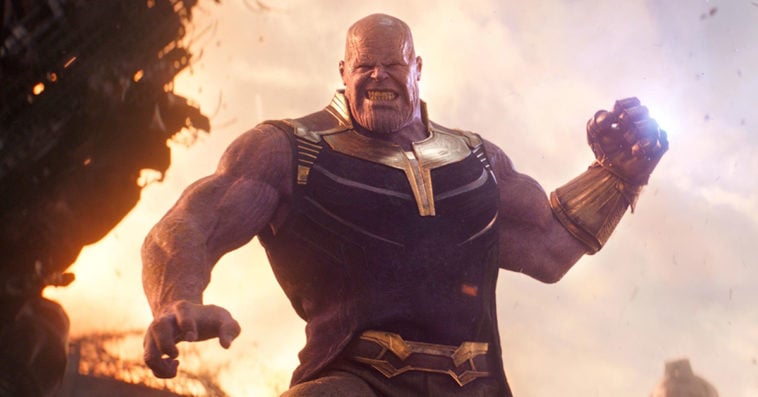
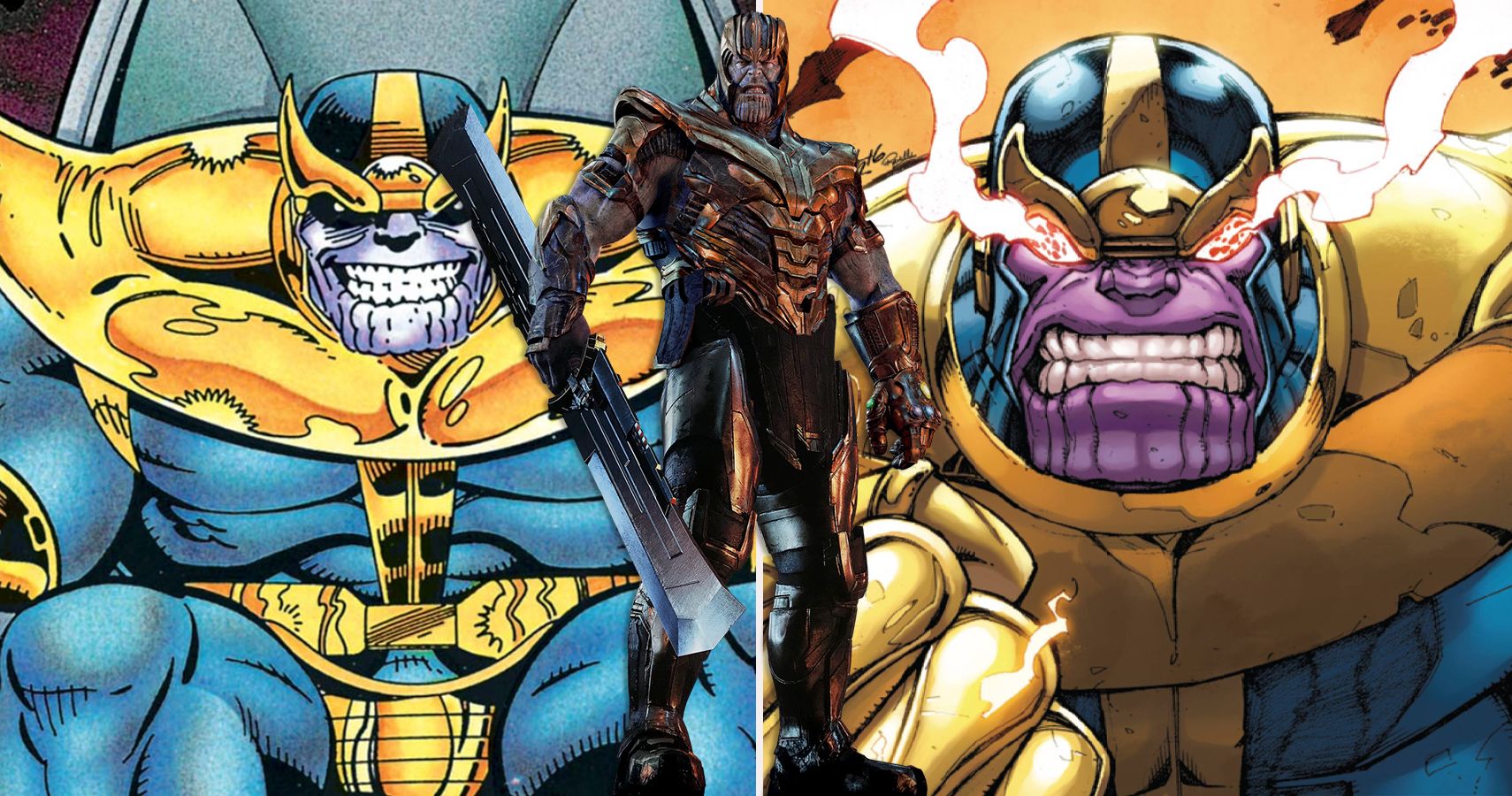
First, let’s talk about who Thanos is in the MCU: he is NOT the same Thanos as in the comics. Comic book Thanos is undoubtedly evil, full of malice and haunted by Death (literally – death first appears to him as a child in the form of a girl and he goes on to have a rather bizarre romantic fixation with her). The 2013 limited series “Thanos Rising” told the story of how Thanos was born and immediately drove his mother insane, then later killed her, and finally destroyed his entire planet in a nuclear bombardment out of spite. He is constantly associated to death, murder, destruction, and mayhem. He’s a bad dude.
MCU Thanos, however, isn’t portrayed in the same light. From the start, he’s shown as a character of greater depth; not meant as mere foil to the heroes of the story, he seems genuinely regretful at times of the actions he’s taking, as if they are a necessary means to an end that is completely justified. I mean look at this guy – the visual comparisons alone are stark (har!) –
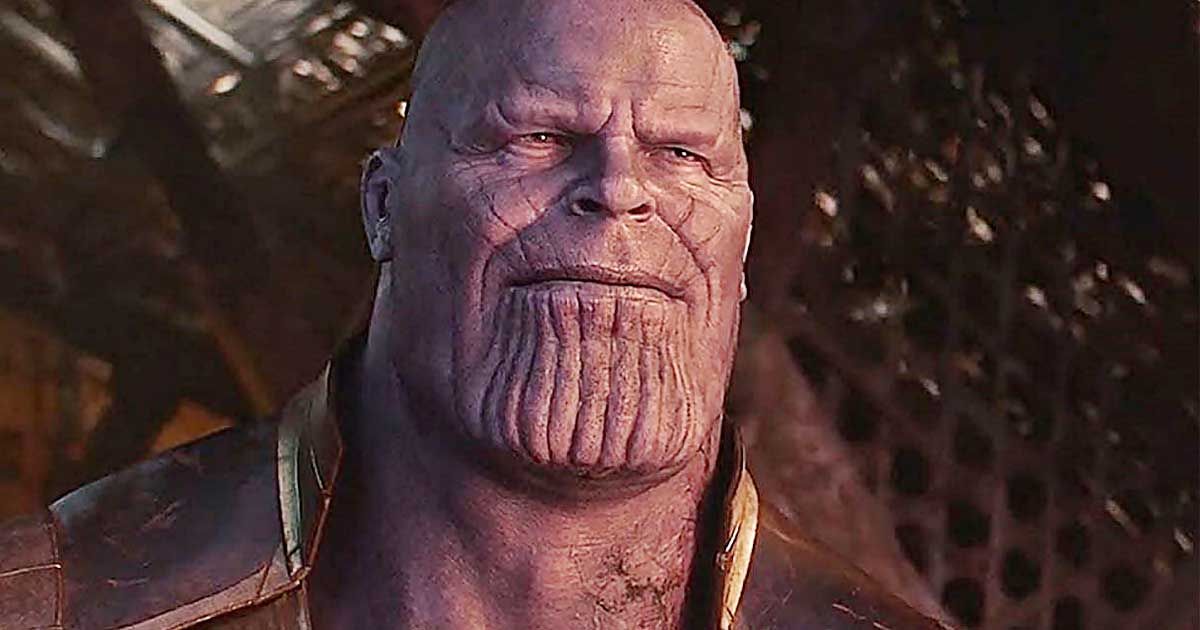

In the MCU, Thanos’s back story is a bit more altruistic. Instead of destroying his planet in retribution, his planet was destroyed by its own failings despite his rather genocidal solution of killing off a large chunk of the population. A scene in Infinity War describes this best, while he is showing what became of his home planet to Doctor Strange:
Thanos: It was beautiful. Titan was like most planets: too many mouths, not enough to go around. And when we faced extinction, I offered a solution.
Strange: Genocide.
Thanos: At Random. Dispassionate, fair. Rich and poor alike. They called me a madman. And what I predicted came to pass.
-Avengers: Infinity War (2018)
Despite this harsh approach, his intention is the salvation of his planet, not the destruction of it. This a huge difference, and one that carries throughout his time in the MCU so far as we’ve seen. Things change a bit in Endgame – but only after the Avengers meddle with time and show to what lengths they will go to in order to thwart Thanos’s plan. At that point, he changes his goal to destroy all life and let everything start over again. He maintains that this goal is not for the sake of death, as would be for his comic book counterpart, but instead in an effort to create a “grateful universe”.
Here he also says that he hoped by ending half of all life, the other half would thrive. Coupled with his exchange (above) with Doctor Strange, it is clear that his overall concern is overpopulation. The most obvious reason for overpopulation being a concern is resource scarcity – which is hinted at when Thanos mentions “too many mouths, not enough to go around.” If this was solely the problem, there are glaring issues with Thanos’s plan.
The first is something that is almost a plot whole. If Thanos is being as altruistic as he seems, why not just use the infinity stones to increase the available resources in the universe? This would have required nobody being snapped out of existence and would have had the same end result: extending the amount of time until all living creatures in the universe burn through the resources available to them. I mean, Thanos could have just created whole planets throughout the universe in opposite orbit of each other, copies of one another, and transferred half of the population to the new planet, right? There are tons of options available here that wouldn’t have required mass genocide, if we conclude that the issue is the ratio of living creatures to available resources.
The other issue is the timing. Overpopulation is something that even we humans are aware of as an eventual concern, but it won’t turn to globally catastrophic levels for many, many years. It should be assumed that we, as a species, would be able take some action ourselves, without outside interference, to keep on keepin’ on. Why, then, was Thanos’s people not able to do that? How did it seemingly reach a point where the only solution was immediate, mass, global murder? This seems to indicate a sense of urgency that doesn’t fit with simple overpopulation.
Something seems to be affecting this clock outside of simple overpopulation compared to natural resource scarcity. What would require immediate, drastic action, dictating that the best solution of all possible options was to remove half of all living creatures from the universe?
My theory – this is a misdirection. Thanos’s motivations are not borne of a disparity between life and resources. The threat to the galaxy was not solvable by increasing available resources, but only by removing life. In fact, if what I propose is true, then creating more resources would make things worse.

Because Galactus.
If Thanos is bad news, this guy is a death in the family. Galactus is a literal world devourer. His origins predate the big bang, from which he is the only survivor from a prior universe. He wields the Power Cosmic. He’s essentially immortal and able to do anything. He might not be as powerful as the combined infinity gems, but he’s close, and we can wield that power indefinitely without causing himself harm.
See, the thing with Galactus is he gets really hungry. He’s almost presented as a force of nature – when he gets hungry, and picks a planet to eat, there’s not really much anyone can do to stop it from happening. He invests a small fraction of the Power Cosmic into a herald, an entity that then serves him by traveling the universe looking for planets ripe with life. The more life, the more nourishing the meal. His most famous herald, The Silver Surfer, eventually grows a conscience and actively seeks out planets that do not have sentient life, if he can help it.
See where I’m going with this? If Thanos had increased the amount of natural resources in the universe, it would have only served to draw Galactus to those planets that have an overabundance of life. By instead removing half of all life (living creatures – not plant life – as indicated in the movies) the hope may be that planets with sentient life might seem less attractive to the World Eater. Since this wouldn’t affect plant life, there would still be plenty of lush planets out there with vegetation, insects, and other lower forms of life that would make a great meal for him.
The upcoming Eternals movie looks like it could be a good place for Marvel to start seeding this villain into the MCU. Not only has it been confirmed that Thanos will make an appearance (likely as a dashing, young version of himself), but there is the question of what kind of threat could possibly be levied against them?
For those that don’t know, Eternals are nearly godlike super-beings. Thanos himself is an eternal – imagine Thanos, without the glove, fighting against the combined strength of Thor, Captain America, and Iron Man in the final segment of Avengers Endgame – THAT is an Eternal. Now combine that knowledge with the fact that the Eternals movie stars a cast of heroes each with powers that could rival Thanos. Oh, and those powers? New descriptions leaked not long ago that describes them – of the ten main characters, six of their powers are described specifically as ‘cosmic’ powers. The MCU could be repurposing the term, but in the comics, the Power Cosmic is a very specific thing intimately tied to Galactus.
It is also worth noting that the creators of the Eternals, a race known as Celestials (beings even more godlike and powerful than the Eternals), have already been introduced in the MCU, principally through the Guardians of the Galaxy movies. You might remember the dead celestial that Benicio del Toro’s character, The Collector, resides in?

Or how about the flashback of this Celestial in Guardians Vol. 1?
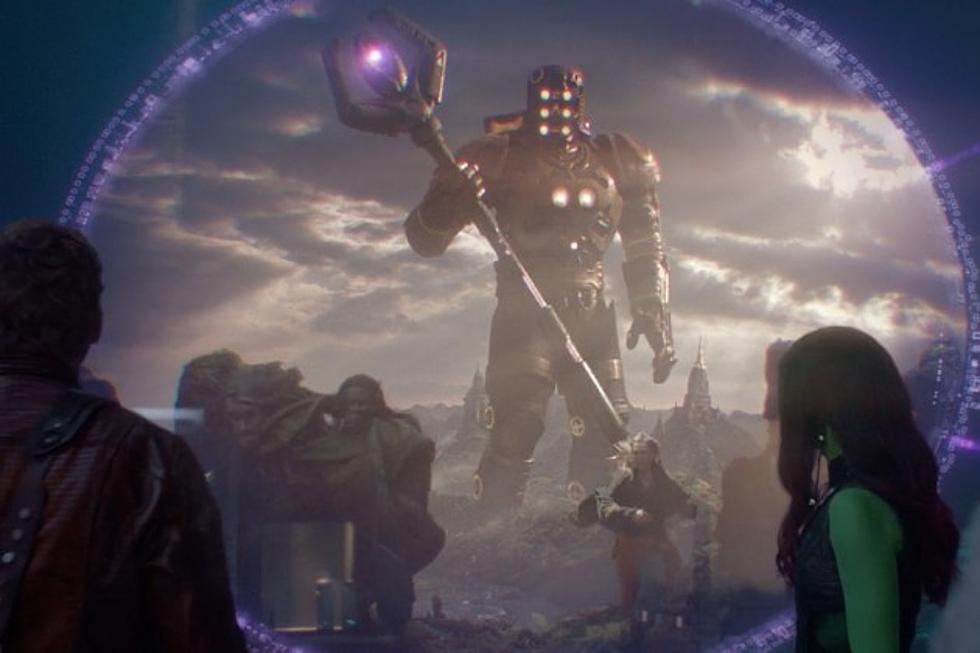
Wait – what is that staff he’s holding – why does that look familiar?
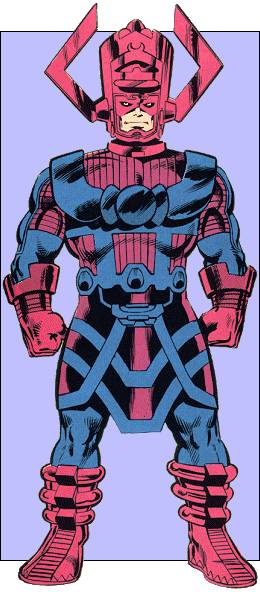
Just saying, there are a lot of connections to be made here. I don’t even think Galactus himself will make an appearance in Eternals – but I’m betting we’ll see one of his heralds. You know, one of those guys that scopes out worlds for their master like some sort of galactic concierge service? The best known of his heralds was this guy:

Now, I don’t think we’ll see the Silver Surfer yet either, but Galactus had several heralds before him. I hope we see one of them – as even divested with only a fraction of the Power Cosmic, given to them by Galactus, a herald would be a formidable foe against a group of Eternals.
When that looming, existential dread hangs over the entirety of Phase 5 and our heroes discover that the exponentially-more-powerful boss of the baddie that wiped the floor with a group of supermen is coming to Earth – will the Avengers wish they had a few more decades to prepare a way to fight back? Thanos’s plans might have given them that time, but they won’t have that luxury, because Galactus is coming – and he is hungry.
So what do you think? Comment below to let me know what your predictions for Phase 4 and beyond will be. Will we see Galactus in the MCU? How do you think they will integrate him into the films? Regardless of how it plays out, I’m so excited to see what the folks at Marvel have in store for us. With 2020 behind us, 2021 and beyond looks awfully sweet. Thanks for reading!


 Plotting Along